
Locality-to-Locality Spreading
An update about what we’re crafting to help neighborhood stewards share, learn, and remix ways we build community where we live.


How can we be slow and small relational tech gardeners, when there are so many other technology builders going fast and breaking things?
Here at RTP, grappling with this question with other local relational technologists has been fun and illuminating.
For the past few months, we’ve been crafting some tools to help neighborhood stewards from around the world share, learn, and remix ways we build community where we live. We have a dream that someone in San Francisco, California, USA (where Josh is now) could learn about what’s happening in Komoro, Nagano, Japan (where Deb is now) to remix learnings in rural Japan to fit within the SF context.
We call this locality-to-locality spreading.
While we might be slower and smaller as gardeners of local tech, we don’t start from scratch like many other builders. Instead, we learn from other gardeners around the world, and we build on our local relationships, asking friends and neighbors who already know us to try out our tech and co-create together.
Today we will focus on three ways RTP is prototyping infrastructure to help with locality-to-locality spreading:
Studio: remixable collection of relational tech stories and tools
Watcher: feed tracking GitHub repos with #relational-tech
MCP server: connector to Studio your favorite AI tool can use
Studio
Relational Tech Studio is the primary way to get a taste of what we’re doing. Studio is where you can read our library of stories of local change, and remix tools enabling that change, such as a block-level information hub in the Outer Sunset, San Francisco; microgrant coordination for neighborhoods in the US; or community supply sharing websites around the world.
Any of the tools you see on Studio can be remixed to your neighborhood, through our Sidekick, a chat that asks you about your neighborhood and suggests a prompt you can copy and paste into any AI building tool, such as Lovable, Dyad, or Claude Code. You can even build a basic first draft on Studio itself for free, in the time it takes to drink a coffee (generative AI credits on us!).
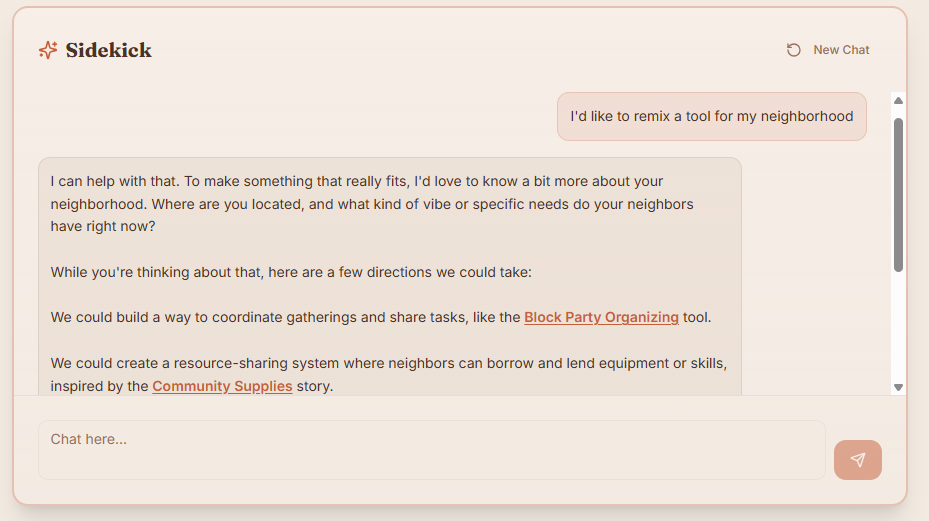
Importantly, you can also submit suggestions of local change stories and interesting tools to be included in our library. We would be thrilled to help you celebrate the care you’ve put into (or seen your neighbors put into) building your community. You can use Sidekick to share more: click 🎁Contribute Something to share your gift with us.
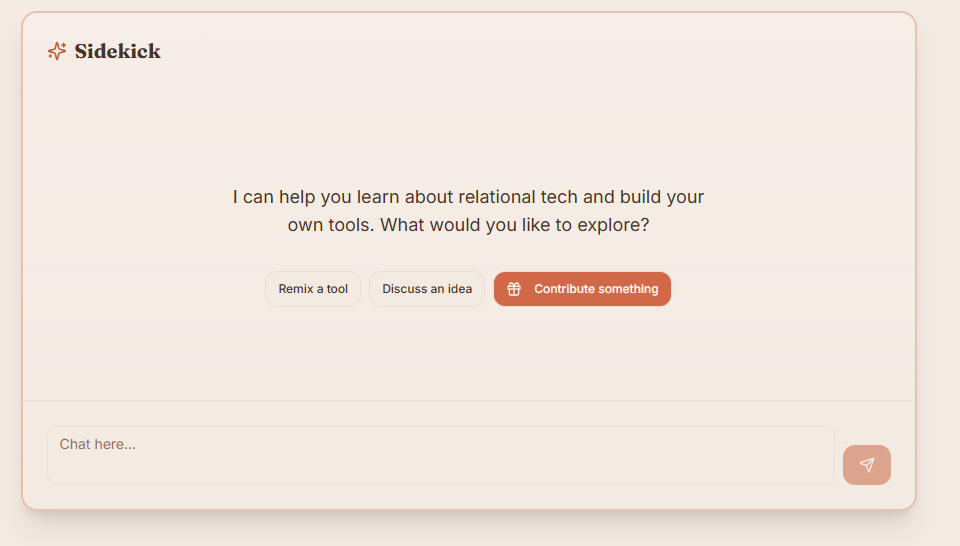
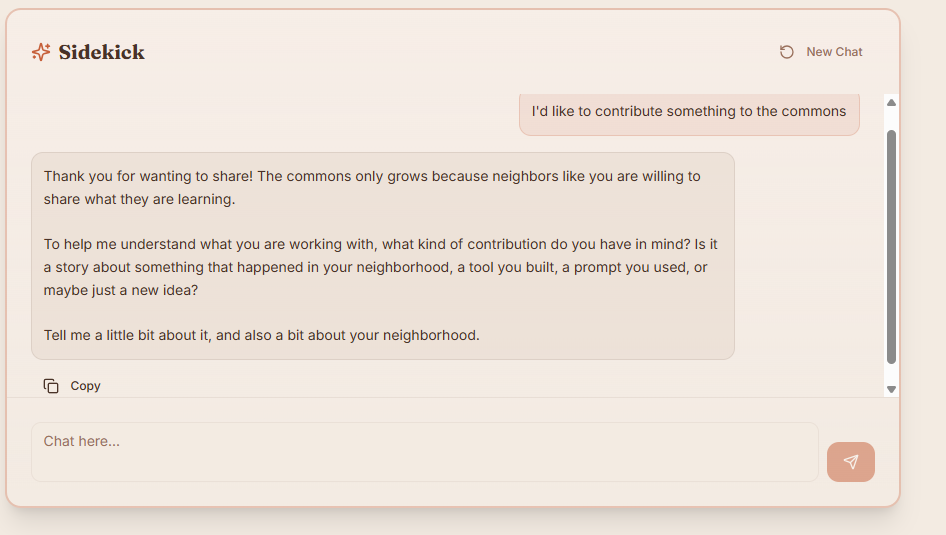
Studio helps you build something quickly, so you can spend less time alone on the computer and more time with your neighbors. You can spend more time asking your neighbors what they dream, building relationships, and navigating conflicts about all the ideas your community has.
This is the work.
When this is done well, with patience and care over time, our technologies will root and flourish (and sometimes compost), and become part of shaping the neighborhoods we want ✨
Watcher
Relational Tech Watcher is a feed that scans public GitHub code repositories tagged with #relational-tech to summarize recent changes. You can access Watcher through your Studio homepage, our updates website, or adding to your RSS feed.
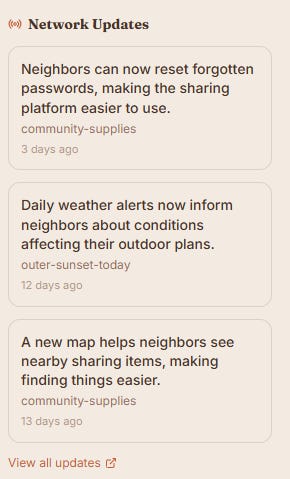
For example, when someone adds a new feature to their local calendar, all they have to do is publish the changes on their GitHub, and Watcher automatically shares the update. Then, someone in another part of the world could read about this update in their feed and decide whether or not to incorporate the idea into their own local calendar.
This way, people can learn from each other across neighborhoods, without anyone needing to explicitly announce or constantly monitor what’s changed👌🏼
MCP Server
This one is a little nerdier, but worth understanding. MCP (Model Context Protocol) is a standard that lets AI tools you’re already using connect to external context. Our Relational Tech MCP server essentially turns on a ‘relational tech mode’ for whatever AI you’re working with. Once you add it, your AI is hooked up to the Studio library, Watcher updates, and our core practices and guiding documents.
What that means in practice: after you’ve connected our MCP server with Claude, Lovable, or your AI of choice, your AI will know about relational tech, including patterns, principles, and examples from around the world. This information will also evolve and change, as local relational technologists contribute to Studio what works in their neighborhoods.
We want to meet people where they are, and we encourage you to use whatever tools feel right for you right now. Let us know if there’s specific relational tech patterns, principles, and examples you want our MCP server to know 🌱
How these pieces fit together
Here’s a sketch of how these tools support locality-to-locality spreading:
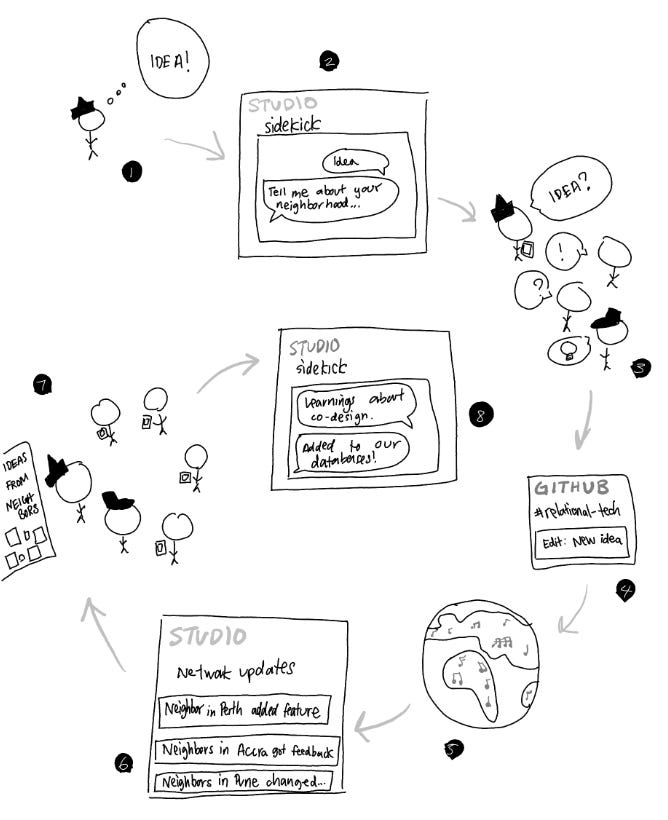
Someone has a dream for their neighborhood.
They log into Studio to build something real, drawing on what others have already made.
They show their build to their neighbors, who suggest changes and ask questions. They invite enthusiastic neighbors to help make a new iteration.
They publish their build on Github with #relational-tech tag, so Watcher picks it up.
Other local relational technologists see the edits and update their #relational-tech Github builds.
Our original relational technologist is inspired by the updates on their Studio’s Watcher feed.
They share some ideas with neighbors. This time, they intentionally facilitate a workshop with neighbors, inviting them to take the driver’s seat and use their phones to brainstorm, build, and test ideas.
They share their learnings about co-design through Studio, and someone around the world using the MCP server with their Claude Code receives different suggestions for next steps of how to ask neighbors for feedback.
Spreading takes trust
Information shared is only useful if people trust the information. A lot of the trust of messages comes from trust of the messenger. So the most important piece isn’t the software. It’s the relationships!
While we build these pieces of software, we’re also cultivating a growing network of local relational technologists. Some are deep into software programming; some have never written a line of code. There’s students, parents, journalists, teachers, organizers, doctors, lawyers, entrepreneurs, civil servants, farmers, gig workers, job seekers, and more. There’s renters, owners, nomads, and landlords. Some have degrees, some learned more from the school of life. Most have had many chapters in their lives and hold many of these identities simultaneously.
What they share is deep care of their neighborhoods and a commitment to show their care through bringing neighbors together, by co-creating relational tech both online and on land.
Our work as RTP is to offer opportunities and nudges for these incredible humans to share ideas, co-build together, host each other in their neighborhoods, organize workshops together, and support each other. More details on this in a future post.
Start small, with others
Let us be honest. Most of the time, people are not remixing tech from Studio, Watcher, or the MCP Server on their own. They’re more likely to quickly scan Studio’s library for some inspiration to spark ideas with their neighbors, maybe including their beyond-human neighbors too. They might briefly check Watcher on a call together and ask each other questions about the rationale behind feature changes. They may have read this article about community supplies and reached out to our RTP team to ask for personalized help setting up their own instance.
Of course, it is more friction to build with others, but we want our relational tech to be, well, relational. Friction makes this locality-to-locality spreading stickier, and we want these relationships to last.
So we’re co-creating these tools openly, alongside other relational technologists and our neighbors. None of it is finished, most is emergent, and all of it is in progress. Our inner perfectionists are struggling 🙃
Still, we invite you to try out and see if our offerings support your journey!
Here’s some ways to get started:
Visit Studio and make a profile. Try building something small to share with your neighbors, and if you want, request a gift build session with an RTP Steward. Contribute a story about your neighborhood or a cool neighborhood tool you’ve used!
Add our MCP server to your AI workflow if you’re already using one.
Browse our open-source repos and fork what’s useful.
Subscribe to our events calendar to receive emailed invites to upcoming events, mostly online for now.
We welcome your feedback, questions, and other gifts here on the comments or via our contact form. Thanks for reading! 🎁